



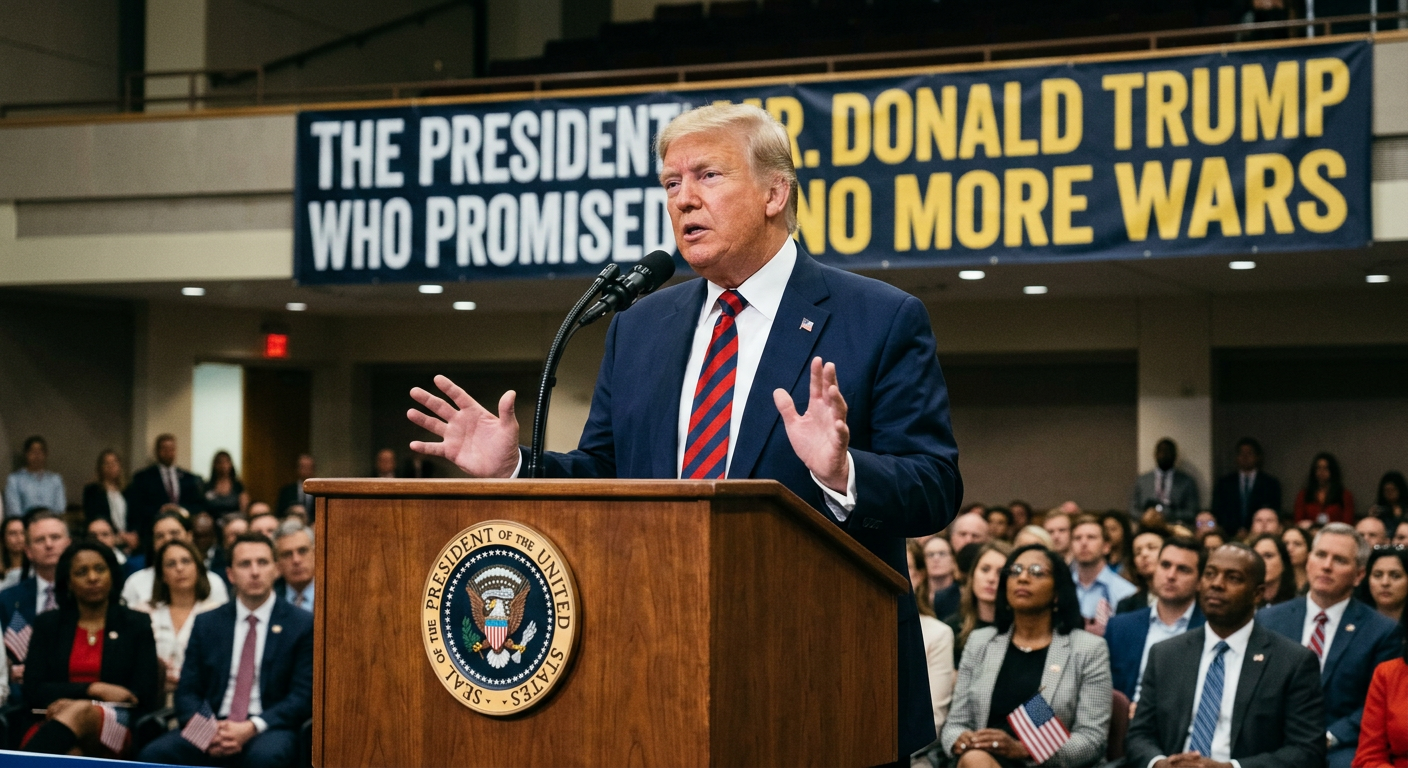
The President Who Promised No More Wars has faced significant scrutiny regarding his war policy. Despite his assurances, the Iranian conflict and subsequent military actions suggest a departure from his original commitments. The administration’s aggressive stance, marked by extensive airstrikes and interventions in foreign affairs, raises questions about the true nature of his promises. As the 2024 electoral landscape unfolds, voters are left to reconcile these actions with the pledge of a more peace-oriented approach.
A war that was supposed to be short
Iran was meant to be the next Venezuela. Trump told Fox News as much, calling Venezuela the template for how Iran would go. It hasn’t gone that way.
The US and Israel began striking Iran on Feb. 28. Trump first said the war would last about four to five weeks, but that the US could go far longer. By April, he was telling reporters the US would “leave” within two or three weeks. That didn’t happen. A two-week ceasefire, mediated by Pakistan, was agreed in April, but it collapsed months ago.
The sticking point is the Strait of Hormuz. About a fifth of the world’s oil and gas normally passes through it. Iran closed it when the war began, and both sides now blockade it. In late September, Tehran put a plan on the table. It would reopen the strait and restart nuclear talks within seven days if Washington lifted its naval blockade, waived sanctions on Iranian oil and agreed to a ceasefire that included Lebanon. Trump rejected it.
He insists he is winning. He told TIME that Iran is “ready to fold up,” that he doubts there can ever be peace with it, and that US attacks could resume after the midterms if there is no satisfactory agreement. Critics point out that he hasn’t offered an alternative. One analyst said Trump seems content to stay in limbo, even as many Americans worry the conflict is becoming another never-ending war. Quietly, mediators are still working with both sides on a deal.
The administration’s defense is simple. Defense Secretary Pete Hegseth told Congress the cost was justified because the goal is to keep Iran from getting a nuclear weapon. That is the argument Trump will have to win with voters, and so far he isn’t winning it.
The bill
Nobody agrees on exactly what the war has cost, which is itself telling. The Pentagon’s inspector general reported $33.4 billion as of late June. The Congressional Budget Office counted more than $38 billion by August, and the most recent figure in AP reporting is $43.5 billion.
The numbers that matter more to most families are smaller and closer to home. The CBO expects inflation to run half a percentage point higher heading into 2027 because of the war. People feel it at the pump. A Marquette poll in early September found that 80% of adults said gas prices had risen over the past six months, and only 20% approved of how Trump was handling them.
Then there is the Pentagon’s own budget. The White House has asked for $1.5 trillion for fiscal 2027, a jump of more than 40% in a single year and the sharpest since World War II. The plan is to push more than $1.1 trillion through regular appropriations and another $350 billion through a party-line process that sidesteps Democrats, all while the country runs deficits near $2 trillion with debt above $39 trillion. One detail stands out. The Pentagon’s acting comptroller admitted the budget was put together before the conflict with Iran began. The war’s costs come on top of it. The White House also asked Congress for $67 billion in emergency war funding, which was stuck for weeks.
Congress can’t stop it, and voters aren’t happy
Lawmakers have tried. The House has passed war powers resolutions three times. The Senate narrowly rejected the latest one, the 14th time it has taken up such a measure. Without enough votes to override a veto, these efforts rarely change anything.
Public opinion has moved faster than Congress. In Marquette’s September poll, 73% disapproved of Trump’s handling of Iran and 79% said the war wasn’t worth what it has cost. Republicans who once cheered the war on have started worrying about its toll, and Trump has said he would “never apologize” for the higher prices.
What comes next
The war has a few possible endings, and each depends on something Trump controls. A deal on Hormuz would probably bring the fastest relief at the pump. A resumption of strikes after the midterms would do the opposite. And Congress will have to decide whether to fund all of it, which will test how united Republicans really are. Allies are watching too. Trump has already threatened to pull the US out of NATO.

