



As the 2026 midterm elections approach, American politics is being pulled in several directions at once — an aggressive immigration crackdown that keeps generating fatal confrontations, a president publicly questioning the integrity of the country’s own voting systems, a nationwide redistricting fight that has already reshaped the House map, and a foreign policy dominated by an unresolved war with Iran. Here’s where things stand.
Immigration Enforcement Under Growing Scrutiny
Immigration remains the most combustible domestic issue of the moment. The Trump administration’s deportation campaign has relied heavily on ICE traffic stops and raids, and a string of fatal shootings by federal agents has kept the policy in the headlines through July.
In the span of about a week, two men were killed: Lorenzo Salgado Araujo, a 52-year-old Mexican immigrant, was shot in Houston on July 7 after ICE agents said he tried to ram their vehicle during a stop; six days later, Johan Sebastián Durán Guerrero, a 25-year-old Colombian father, was shot and killed during a slow-speed stop in Biddeford, Maine. In both cases, and in similar shootings earlier this year, federal officials have offered a common explanation — that the driver “weaponized” his vehicle — an account that families’ attorneys and rights groups have repeatedly disputed. Rights organizations say more than 60 people have died in ICE shootings or in immigration detention since the administration returned to office.
The deaths have triggered vigils and protests in cities including Minneapolis, Portland, Los Angeles, New York, and Washington, D.C. Reports emerged mid-month that the Department of Homeland Security was considering pausing ICE vehicle stops in response, but the White House shut that down: Press Secretary Karoline Leavitt said on July 16 that stops would continue, calling them a “necessary tool” for the administration’s deportation campaign. Some Democratic lawmakers have called for Homeland Security Secretary Kristi Noem to be held accountable, though no formal action has advanced.
Trump’s Primetime Speech on “Rigged” Elections
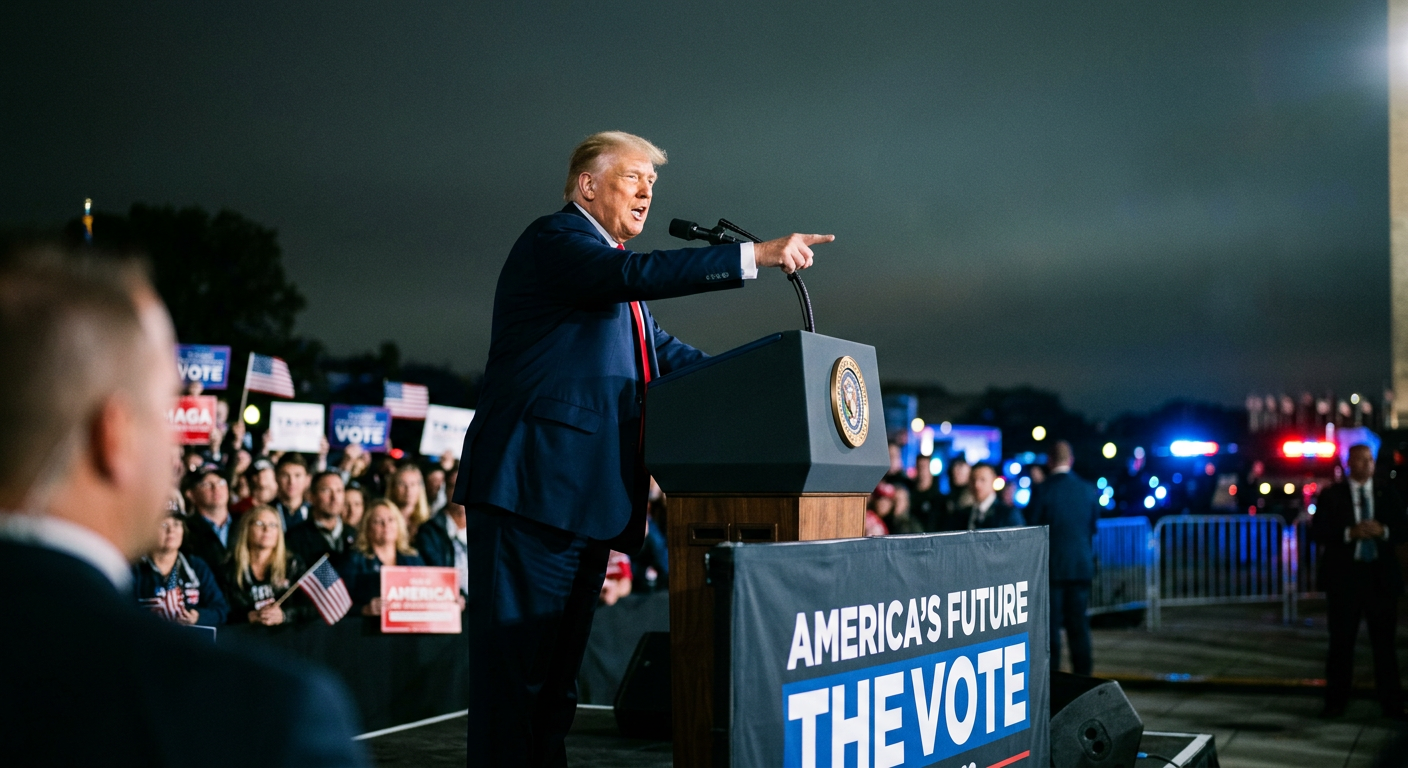
On July 16, President Trump delivered a 25-minute primetime address from the White House East Room devoted to election security — reviving his long-standing claims that US elections are vulnerable to being “rigged and stolen.” He announced the declassification of intelligence documents he said showed foreign actors, particularly China, had compromised voter data in several states, and cited a Department of Homeland Security report claiming roughly 278,000 non-citizens were found registered to vote in federal elections.
Fact-checkers and election security experts who reviewed the documents afterward found no new evidence of actual fraud or altered vote totals, noting that Trump’s own Cybersecurity and Infrastructure Security Agency had called the 2020 election “the most secure in American history.” The speech was widely seen as an effort to build momentum for the SAVE America Act, a Republican-backed bill that would impose nationwide voter ID requirements and mandate proof of citizenship for registration — legislation that remains stalled in Congress. The Justice Department is separately suing more than two dozen states to compel them to hand over unredacted voter rolls for a DHS citizenship-screening effort, though courts have repeatedly blocked those attempts.
The Redistricting Wars
Perhaps the most consequential — if less headline-grabbing — political story of the cycle has been an unprecedented mid-decade redistricting fight. It began in mid-2025 when Trump pushed Texas Republicans to redraw the state’s congressional map to net the GOP up to five additional House seats ahead of the midterms. Democratic state legislators temporarily fled Texas to block a vote, but the map ultimately passed and, after a legal fight, was upheld by the Supreme Court in December 2025.
That set off a cascade. Nine states — Alabama, California, Florida, Missouri, North Carolina, Ohio, Tennessee, Texas, and Utah — have now redrawn their congressional maps in this cycle. California Democrats answered Texas directly, passing a new map via a ballot measure (Proposition 50) that could hand the party up to five additional seats, effectively canceling out Texas’s gains; the Supreme Court declined to block it. The Court also let Alabama and Louisiana adopt new Republican-favored maps after earlier rulings on the Voting Rights Act reshaped what states could do. Georgia, Louisiana, and South Carolina appear likely to redraw again, though not necessarily in time for this cycle, while some Democratic-led states — New York, Maryland, Illinois — are weighing their own moves ahead of 2028.
The net partisan effect is contested, but most analysts see Republicans gaining a modest edge nationally, given they entered 2026 defending a narrow 218-213 House majority. Whether that redistricting advantage holds up against the traditional midterm headwinds facing the president’s party remains one of the central questions of the cycle.
Foreign Policy: The Shadow of the Iran War
Domestic politics is unfolding against the backdrop of America’s ongoing war with Iran, which began in February 2026 and has recently reignited after a ceasefire frayed over control of the Strait of Hormuz. The conflict has become entangled with domestic politics as well: the administration has convened international partners around efforts to counter what it calls “left-wing political terrorism,” and the war’s economic ripple effects — from oil price volatility to shipping disruptions — are feeding into the broader economic debate ahead of the midterms.
The Bigger Picture
Taken together, these threads point to a political environment defined by unusually high stakes and unusually low institutional trust on multiple sides. The administration is leaning hard into both immigration enforcement and election-integrity messaging as core midterm themes, while facing sustained criticism over the human cost of ICE operations and skepticism from election experts over its fraud claims. Meanwhile, the redistricting battle has already partially determined the shape of the House map before a single midterm vote is cast, ensuring that however the public breaks in November, the playing field itself was heavily contested well in advance.

