



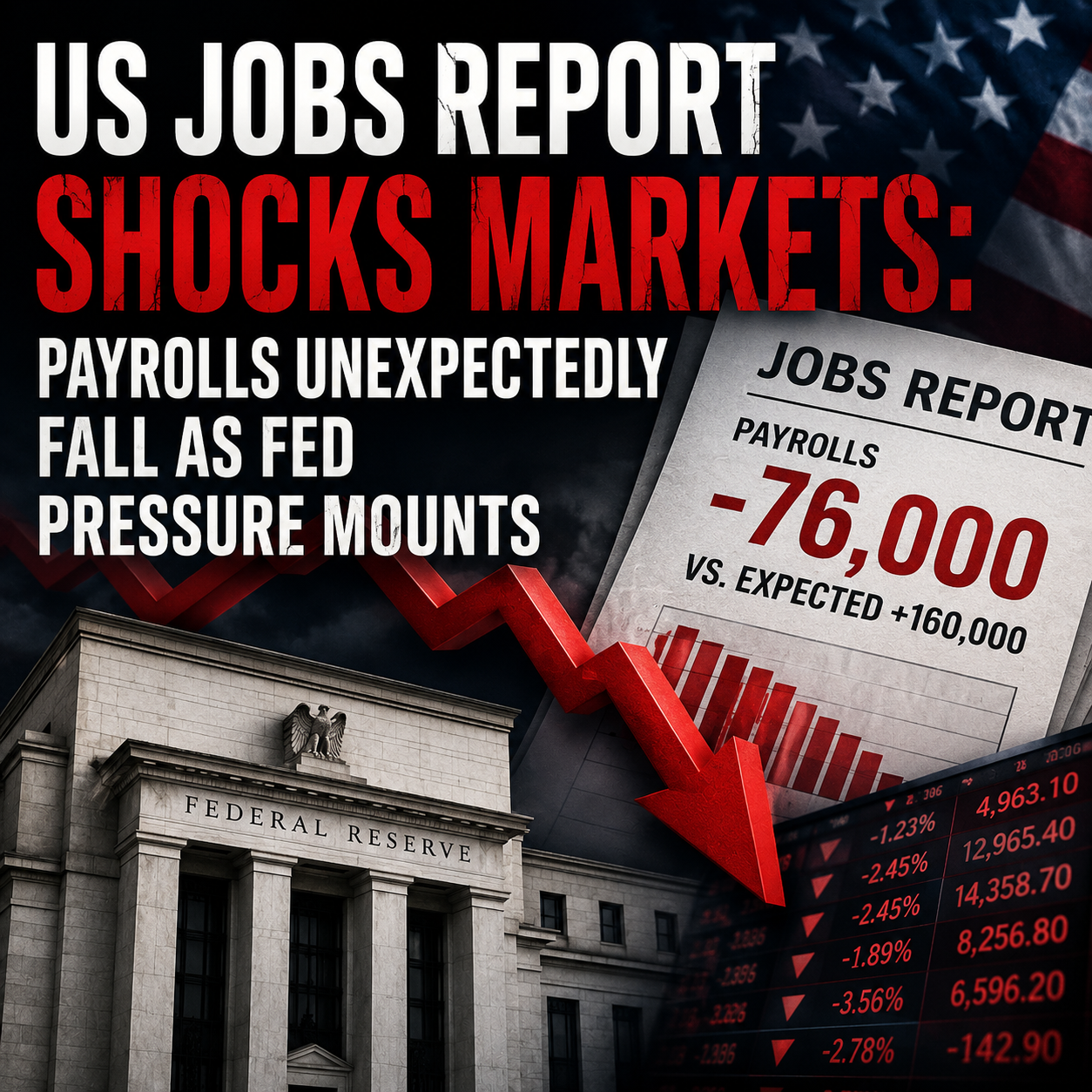
The US labor market delivered its most unsettling reading in months on Friday, August 7, when the Bureau of Labor Statistics reported that employers cut 23,000 jobs in July — the first outright payroll decline in recent memory and a sharp reversal from the modest gains economists had penciled in. The miss, combined with steep downward revisions to prior months, has reopened the debate over how much trouble is brewing beneath an otherwise resilient-looking economy.
The Numbers
Nonfarm payrolls fell by a seasonally adjusted 23,000 in July, badly missing expectations. Forecasts varied slightly by source — Dow Jones-polled economists had expected a gain of roughly 83,000, a Bloomberg survey pointed to about 80,000, and Barron’s put consensus near 95,000 — but every estimate anticipated solid growth, not an outright contraction. Compounding the surprise, June’s previously reported gain of 57,000 was revised down to just 20,000, and May’s figure was slashed from 129,000 to 63,000. Taken together, employment in May and June combined was 103,000 lower than previously reported, meaning the labor market has been considerably weaker over the summer than the government initially indicated.
The unemployment rate ticked down slightly to 4.1% in July from 4.2% in June — a counterintuitive move alongside a payroll decline, driven in part by a labor force participation rate that fell to 61.4%, its lowest level in more than five years. Other details in the report point to a market that’s cooling more broadly:
- Where the losses came from: Local government education shed 50,000 positions and retail trade lost 19,000 jobs, with warehouse clubs, supercenters, and general merchandise retailers accounting for much of the retail decline.
- Temporary layoffs rising: The number of people on temporary layoff jumped by 153,000 to 921,000 in July.
- Long-term unemployment persistent: 1.8 million people have now been jobless for 27 weeks or more, accounting for 25.5% of all unemployed people.
- Wages still growing: Average hourly earnings for private-sector workers rose 2 cents to $37.62, up 3.2% over the past year — a sign that whatever is happening in the labor market isn’t (yet) showing up as broad wage weakness.
- The household survey diverges further: The BLS’s separate household survey — which captures self-employment and doesn’t break out industry detail — has shown total civilian employment declining by roughly 833,000 since January, even as the payroll survey (the one generating headline numbers) has continued to show modest job gains most months. The gap between the two surveys has been one of the more debated features of the 2026 labor market.
Markets Rallied Anyway
Despite the weak headline number, Wall Street’s reaction was to buy, not sell. The logic: a softer labor market reduces the odds the Federal Reserve will need to raise interest rates, and markets have consistently rewarded anything that points toward looser monetary policy this year.
- The S&P 500 rose 0.6% to a record close of 7,757.64, adding to a high it had set earlier in the week.
- The Nasdaq Composite jumped 1.3% to 26,690.62, powered by a rebound in chip stocks — the iShares Semiconductor ETF gained more than 7% on the week.
- The Dow Jones Industrial Average added roughly 152 points, or 0.3%, closing just short of its own recent record.
- All three major indexes notched a second consecutive week of gains, with the S&P 500 up 3.6% and the Nasdaq up about 5% for the week.
- In bond markets, the 2-year Treasury yield fell to 4.18% and the 10-year slipped to 4.62%, as traders priced in a lower probability of near-term rate hikes.
- The dollar weakened and spot silver rose 5% to a six-week high of $64.57 an ounce, tracking gold higher as soft hiring data and lower oil prices boosted demand for precious metals.
Strong corporate earnings helped cushion the blow. With nearly 90% of S&P 500 companies having reported second-quarter results, analysts were tracking profit growth of roughly 50% overall — the strongest pace since 2021 — which has helped justify the market’s continued climb even as labor data softened.
The Fed’s Dilemma
The jobs report lands at a delicate moment for the Federal Reserve, now chaired by Kevin Warsh. Morgan Stanley Wealth Management’s chief economic strategist, Ellen Zentner, summed up the market’s read in a research note: “Today’s weak payrolls print may ease the pressure on the Fed to raise rates at its September meeting, but next week’s inflation data will still likely be the deciding factor.”
That framing reflects an unusual dynamic this year: rather than debating rate cuts, markets have spent recent months bracing for the possibility of a rate hike, given that inflation hit a three-year high of 4.2% in June — driven substantially by energy costs tied to the ongoing war with Iran and the resulting disruption to oil markets. Money markets are still pricing in a Fed hike sometime in 2026, but now see it as unlikely before December rather than at the September meeting. The Fed held rates steady at its most recent meeting in a unanimous vote, and a recent public survey found 55.1% of respondents thought that decision was correct, while 30.6% said the Fed should have raised rates and only 5.6% favored a cut.
President Trump, who has repeatedly pushed for lower interest rates, has been publicly skeptical that a hike is warranted at all — a position now somewhat bolstered by the weak jobs data, even as inflation concerns tied to the Iran war continue to complicate the Fed’s calculus.
The Bigger Picture: A Slowing Labor Market All Year
July’s contraction didn’t come out of nowhere — it caps a broader slowdown that’s been building for months. Job growth averaged 92,000 per month over the first half of 2026, itself a marked cooldown from the pace of prior years, before June’s already-soft 57,000 gain (since revised down to 20,000) signaled further weakening. The BLS also noted that October 2025 data were never collected due to a federal government shutdown, adding another gap to an already inconsistent data picture over the past year.
Taken together, forecasters now face a genuinely mixed signal: a labor market that’s clearly losing momentum and, by some measures, already shrinking; an inflation rate elevated by war-driven energy costs; and a stock market that keeps hitting records anyway, buoyed by blockbuster corporate earnings and hopes that a cooling economy will keep the Fed on hold. How long markets can keep reconciling a weakening jobs picture with record-high stock prices is likely to be one of the defining economic questions heading into the fall.
This account reflects reporting available as of August 8, 2026. The next major data points to watch are the August inflation report and the Fed’s September meeting, both of which are expected to weigh heavily on how markets and the Fed respond from here.

