



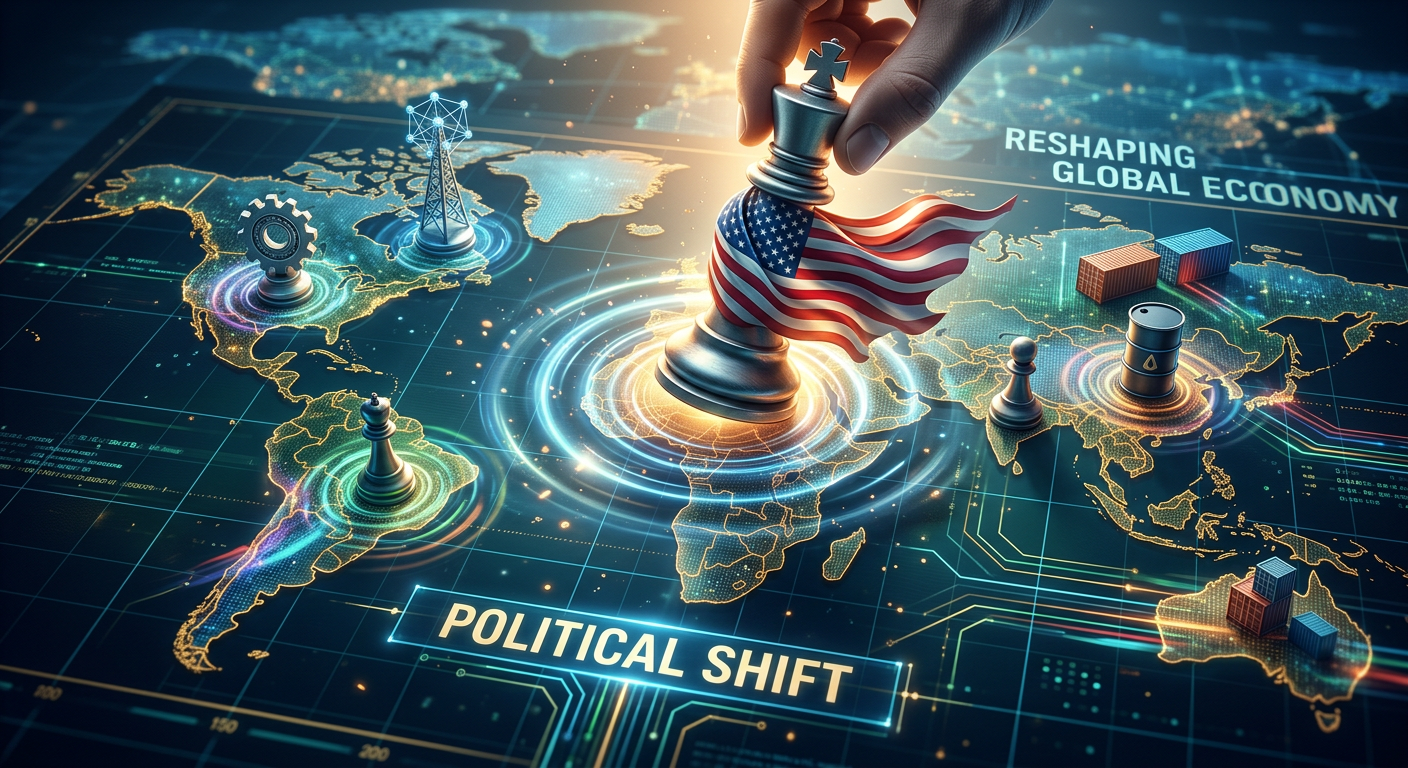
American domestic politics rarely stays domestic for long — but in 2026, the spillover has been unusually direct. A tariff regime rebuilt after a Supreme Court defeat, a Federal Reserve caught between a president who wants lower rates and inflation that keeps climbing, and a war with Iran that has repeatedly shut down one of the world’s most important oil chokepoints have combined to make Washington’s political decisions a daily variable in markets from Frankfurt to Mumbai.
Tariffs: Struck Down, Then Rebuilt
For much of 2025, President Trump’s global tariff program ran on the International Emergency Economic Powers Act (IEEPA), letting him impose sweeping duties — reciprocal tariffs of 10-46% on more than 80 countries, plus steep sector-specific rates on steel, aluminum, copper, semiconductors, and pharmaceuticals — without direct congressional approval. That ended on February 20, 2026, when the Supreme Court ruled 6-3 that IEEPA didn’t give the president authority to impose tariffs as a form of taxation, striking them down permanently.
It was a short-lived reprieve. The administration pivoted immediately to a temporary 10% global tariff under Section 122 of the Trade Act, then began rebuilding a comparable structure using slower but more legally durable authorities — Sections 232 and 301 — targeting individual sectors and countries one at a time. By July, the Council on Foreign Relations described this “brick-by-brick reconstruction of the great tariff wall” as nearing completion, with new duties on major trading partners converging back toward pre-ruling levels. A US-EU trade deal took effect July 1, capping most European goods, autos, pharmaceuticals, and semiconductors at a flat 15%.
The economic effects have been real and unevenly distributed. The average US tariff rate dropped from nearly 10% in January to roughly 6.7% after the court ruling, and overall imports rose more than 15% — except from China, where import values kept falling despite the tariff relief, down nearly 7% since February. The Tax Foundation estimates the 2026 tariffs amount to the largest US tax increase as a share of GDP since 1993, costing the average American household roughly $1,500 this year. The IMF has separately warned that the trade war is dragging on global growth “in the short and the long term,” projecting global growth slowing toward 3.1%, with much of the consumer price impact still working its way through supply chains rather than having hit shelves yet.
A Federal Reserve Caught Between the President and Inflation
US monetary policy has become an unusually public tug-of-war. Trump spent much of 2025 pressuring then-Chair Jerome Powell for faster rate cuts, at one point calling him a “stiff” after the Fed delivered a quarter-point cut he wanted doubled. Kevin Warsh, seen as more sympathetic to the administration’s preference for lower rates, took over as Fed chair in mid-2026.
But inflation has complicated the political wish for cheaper borrowing. Consumer prices hit a three-year high of 4.2% in June, driven substantially by a 23.5% jump in energy costs tied to the Iran war. At Warsh’s first meeting as chair, the Fed held rates steady at 3.5-3.75% in a unanimous vote — a notable contrast to the divided committee under Powell — and signaled it now expects to raise rates slightly by the end of 2026 rather than cut them, even as Trump told reporters a hike seemed “hard to believe.” The episode illustrates a broader dynamic: geopolitical decisions made in Washington (the Iran war) are now feeding back into the same administration’s economic goals (lower rates), constraining the Fed regardless of who sits in the chair.
The Iran War Is Repricing Global Energy in Real Time
Nothing has connected US politics to world markets more directly this year than the war with Iran and its recurring closures of the Strait of Hormuz, the passage that carries roughly a fifth of the world’s oil. Each time Iran has shut or threatened to shut the strait — most recently in mid-July, after the ceasefire frayed — oil prices have jumped and equity markets have wobbled in response. As of July 17, oil prices had risen roughly 13% over the preceding week alone, with Brent crude trading around $84 a barrel and WTI near $80, driven by the combination of a US naval blockade on Iranian ports and Iran’s own closure of the strait.
Earlier, sharper spikes during the initial weeks of the war pushed Brent above $100 a barrel and sent the VIX volatility index up nearly 20% in a single week, with capital rotating out of growth stocks and into traditional safe havens. The effects have rippled well beyond the US: major oil-importing economies, India among them, have seen their own equity markets fall in tandem with strait closures, while shipping and insurance costs for tankers routing around the Gulf have climbed. Energy majors and defense contractors have been among the few consistent winners as markets price in a sustained “war premium.”
Why This Matters Beyond the US
Three separate Washington-driven forces — tariff policy, monetary policy, and a war with direct control over a fifth of the world’s oil supply — are now moving in tandem, and all three trace back to decisions made inside the same administration. That concentration is unusual. In a normal cycle, trade policy, central bank independence, and foreign policy each move on their own timeline, giving global markets multiple, semi-independent signals to read. In 2026, all three are converging on the same set of political choices, which means volatility in Washington translates into volatility everywhere else with less of a buffer than usual.
For the rest of the world, this has meant faster, larger swings in oil prices, currency markets adjusting to an increasingly unpredictable Fed path, and businesses everywhere — from German automakers to Japanese electronics exporters — recalculating supply chains around a US trade policy that can still change with a single Section 232 investigation or a new round of fighting in the Gulf.

