



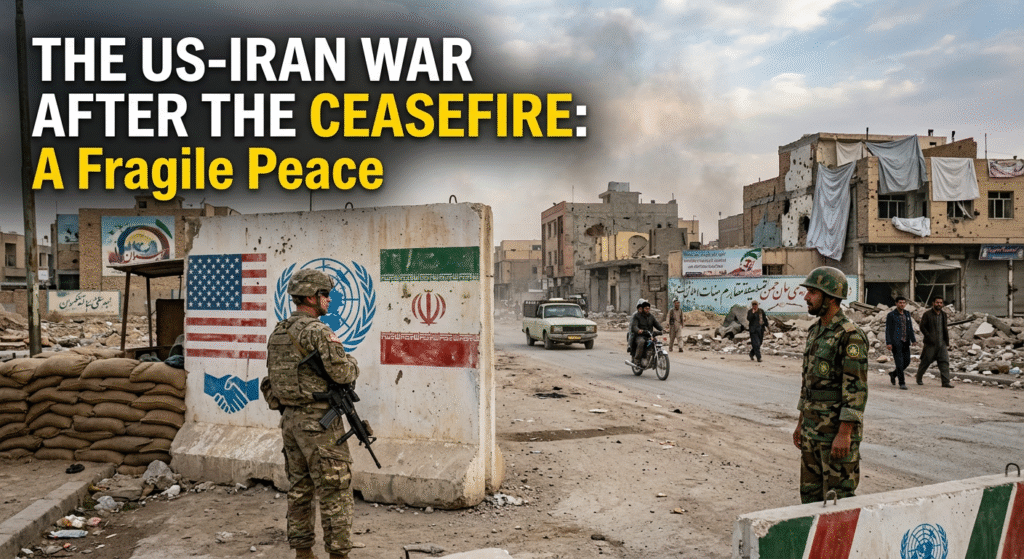
The current US-Iran conflict began on February 28, 2026, when President Donald Trump announced “major combat operations” against Iran, launching massive joint US-Israeli strikes on Iranian military, government, and infrastructure sites. Weeks of intense fighting followed, with Iran retaliating through missile and drone barrages against Israel and US allies across the region.
By mid-April, exhaustion on both sides opened the door to diplomacy. A ceasefire was reached, and on April 13 the United States also imposed a naval blockade on Iran’s Persian Gulf coast after an earlier round of talks in Islamabad failed to produce a lasting deal. Negotiations continued from there, culminating in delegations from the US and Iran meeting in Switzerland on June 22 to begin a 60-day negotiation period. That same month, both sides signed a Memorandum of Understanding (MoU) meant to lay the groundwork for a permanent end to the fighting.
Why the Ceasefire Was Always Fragile
The MoU never fully stopped the shooting. Even after it was signed, the US and Iran continued exchanging limited strikes, with the Strait of Hormuz emerging as the central flashpoint. The document’s language on the strait proved to be its biggest weakness: rather than clearly stating that Iran could not control the waterway, it vaguely called on Iran to “make arrangements” for the safe passage of commercial vessels and to engage with Oman on the strait’s “future administration.” Iran interpreted this ambiguity as a license to assert control over parts of the passage, while Washington insisted Iran had no such authority.
That interpretive gap proved fatal to the truce. Just over a week after the framework deal was signed, Iran launched a drone strike on a ship transiting the Strait of Hormuz — a move the US treated as a ceasefire violation and answered with a round of strikes.
The Collapse: Early-to-Mid July
Tensions boiled over in early July. On July 6, Iran’s Islamic Revolutionary Guard Corps (IRGC) struck three commercial vessels near Oman, including a Qatari LNG tanker. The US responded the next day with retaliatory strikes on Iranian military targets, prompting Iran to fire missiles and drones at US bases across the Gulf.
On July 8-9, the US carried out a fresh, more severe wave of attacks — the most serious since the MoU was signed — hitting the eastern Iranian cities of Iranshahr, Bandar Abbas, Konarak, Chabahar, and Bushehr, along with Aq Qala in the northeast. A US strike also hit an area near Iran’s Bushehr nuclear power plant. On July 9, President Trump declared the ceasefire “over,” though he added that Washington would continue talks. Iran’s parliamentary speaker, Mohammad Ghalibaf, shot back that “Hormuz will only open with Iranian arrangements, not American threats.” At the same time, Vice President JD Vance warned that any Iranian attempt to close the strait would draw a US military response.
In apparent retaliation, the IRGC shut down the Strait of Hormuz entirely around July 12, accusing the US of interfering in the waterway’s management by helping shippers find alternative routes. Oil prices spiked, and markets wobbled on the news. Iran’s late Supreme Leader’s successor, Mojtaba Khamenei, declared that “revenge is the will of the nation.”
Where Things Stand as of Mid-July
As of July 17, the conflict has escalated into a sustained bombing campaign rather than sporadic exchanges:
- Seven consecutive nights of US strikes. US Central Command confirmed a seventh straight night of strikes on Iran on July 17, hitting surveillance sites, military infrastructure, a port surveillance tower used to track shipping, and — according to Iranian claims that the US denies — civilian infrastructure including bridges.
- Iranian retaliation has widened geographically. Tehran has launched missiles and drones not just at Israel and US bases, but at Bahrain, Qatar, Oman, Jordan, and Syria. The IRGC also claimed to have targeted the former US garrison at al-Tanf in Syria (from which US forces had already withdrawn in February).
- Mounting casualties. Iranian officials say 38 people have been killed and more than 400 wounded in US strikes since the Switzerland talks began on June 22, including at least eight to seventeen people in the most recent nights of bombing. Kuwait has reported soldiers wounded and military and civilian facilities damaged by Iranian strikes.
- Shipping under threat. Traffic through the Strait of Hormuz, which normally sees around 110 ships a day, has collapsed to a handful of vessels daily. An Indian crew member was killed when the IRGC struck a merchant vessel, the MV GFS Galaxy, near the strait.
- Warnings of a wider war. A senior Iranian military adviser has warned the US could face a “full-scale offensive” if the bombing campaign continues through the weekend, and an IRGC general said the US has effectively destroyed the MoU, threatening an “offensive phase” if strikes persist.
- Diplomacy hasn’t fully collapsed. Despite declaring the ceasefire over, Trump said the US would continue talks with Iran after Tehran requested it. Mediators have been working to de-escalate tensions and get negotiations back on track, and the US has told the UN Security Council it still prefers a diplomatic solution — while simultaneously imposing fresh sanctions on Iran and insisting it is ready to “hold Iran to account.”
The Core Sticking Point
Nearly every recent flashpoint traces back to the same unresolved question: who controls the Strait of Hormuz. For Iran, asserting authority over the waterway is both a security and economic lever — roughly a fifth of the world’s oil flows through it. For the US and its Gulf partners, any Iranian claim of control is treated as an unacceptable threat to global energy security and freedom of navigation. Until that question is resolved in the text of an agreement rather than left ambiguous, analysts note there’s little reason to expect the current cycle of strikes and retaliation to break on its own.
Outlook
Experts are split on where this goes next. Some point out that the latest exchanges of fire, while intense, are less severe than the strikes that opened the war in late February — suggesting a peace process could still be revived. Others are far more pessimistic, arguing that the Iranian government which signed the ceasefire may lack the authority or incentive to enforce it, given hardline factions pushing for retaliation. With Iran threatening a “full-scale offensive,” the US signaling no immediate plans to de-escalate, and mediators racing to salvage what’s left of the MoU, the coming days are likely to determine whether this remains a bounded exchange of strikes — or tips into the all-out regional war both sides have so far stopped short of.

